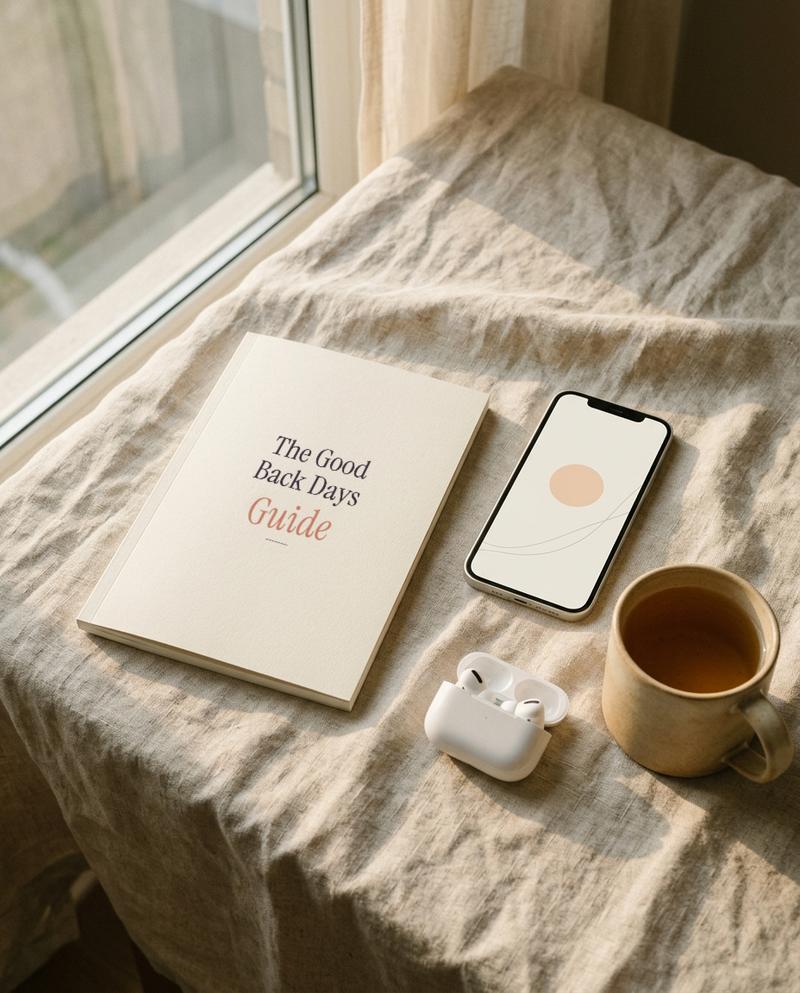
The Good Back Days Guide
Read it tonight. Talk back tomorrow.
Back pain that won't go away is often coming from your brain, not your spine. The Guide shows you how to retrain it, about 10 minutes a day: the guide, word-for-word scripts, a 16-minute bedtime audio and a one-page cheat sheet.
In a University of Colorado study, 2 out of 3 people who learned this were pain-free or close to it after four weeks. Results vary. The science
One payment · Nothing renews · 30-day refund
Not sure it's you? Take the free 2-minute quiz
What's in the Guide.
Read it tonight and play the audio in bed. It's yours to keep, and it's $19 once.
- 30 pages
The guide
Why your back still hurts and how to stop it, in plain words. Every study is linked, and the warning signs that mean see a doctor come first.
- Scripts
What to say back
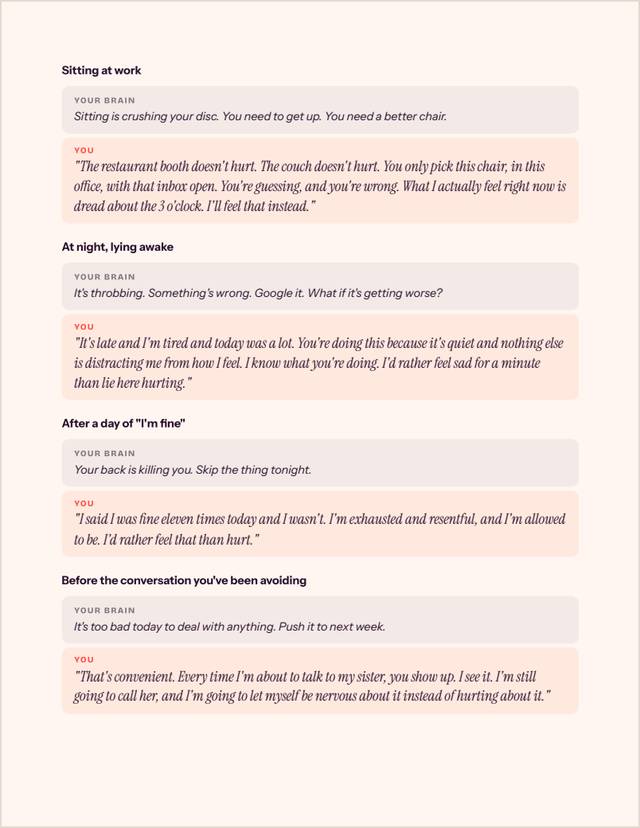
Word-for-word scripts for the morning ache, lifting the kids, sitting at work, and the flare after a fight.
- 16 min
The bedtime audio
About 16 minutes to play as you fall asleep. It walks you through talking back and letting your back soften.
- 1 page
The cheat sheet and the bad-day plan
One page to keep where you'll see it, and what to do in the next ten minutes when it's loud.
What it sounds like on a Tuesday.
When the pain shows up, you tell your brain: "I know what you're doing. I'd rather feel the hard stuff than hurt." Then you let yourself feel the hard stuff, and you go back to your life. Your pain is real and physical the whole time.
It feels silly the first few times. Say it anyway.
Is this you?
An injured disc hurts the same way every time you load it. Pain your brain is keeping going plays tricks. Here's what it does, and what you say back.
It moves around.
Low back this month, hip or shoulder blade the next.
You tell it"You just moved to my hip. Injuries don't do that."
It's better when you're busy.
Fine all day at work, then you sit on the couch and it starts.
You tell it"You were quiet for eight hours. I see what you're doing."
It follows your cycle.
Worse the week before your period, calmer after.
You tell it"Same week every month. I know the pattern."
The scan doesn't match.
You've heard "mild," "normal for your age," or "nothing that should cause this much pain."
You tell it"The MRI said mild. I'm going with the MRI."
Every treatment wears off.
PT, the chiropractor, injections and the heating pad each helped for a while.
You tell it"If PT had fixed a broken back, it would have stayed fixed."
You're scared to move.
You brace before you bend over the crib, before it even hurts.
You tell it"I'm picking her up. You can complain after."
The Good Back Days Program, $59
Want the daily practice? That's the 30 days.
Everything in the Guide, plus a short lesson, a guided session and one thing to try every morning in the app, and a short email each day so you never have to remember. About ten minutes a day.
Start the 30 days, $59
Or start with the Guide and add the 30 days later for $40.

Week 1
Understand it
The guide, in plain words, with the studies. Your first talk-backs. The bedtime audio every night.
Week 2
Catch it in the act
You start noticing what you were about to feel when the pain showed up. Word-for-word scripts for the morning ache, the car seat, the flare after a fight.

Week 3
Move again
Bending, lifting, the stairs. Each day, one small thing you've been bracing against. The bad-day plan is there for the loud days.

Week 4
Make it yours
The twelve daily truths, a plan for when it comes back, and your cheat sheet. By now you're the one running the conversation.
Who it's for, and who it isn't.
It's for you if
A doctor has already ruled out anything serious, and the pain has lasted longer than an injury should. PT, the chiropractor or injections each helped for a while. Your pain moves around, follows your cycle, or backs off when you're busy. Your scan said "mild" or "normal for your age."
Not for you, if
No doctor has examined this pain, or it's brand new. You have a warning sign like new bladder problems or a leg getting weaker (call your doctor today). A disease like rheumatoid arthritis is causing it. Or you want someone else to fix it for you: this only works if you do the ten minutes. If you've been through serious trauma, do this with a therapist.
The Good Back Days Guide
Start tonight. Keep it for good.
$19
once, yours to keep.
One payment. Nothing renews.
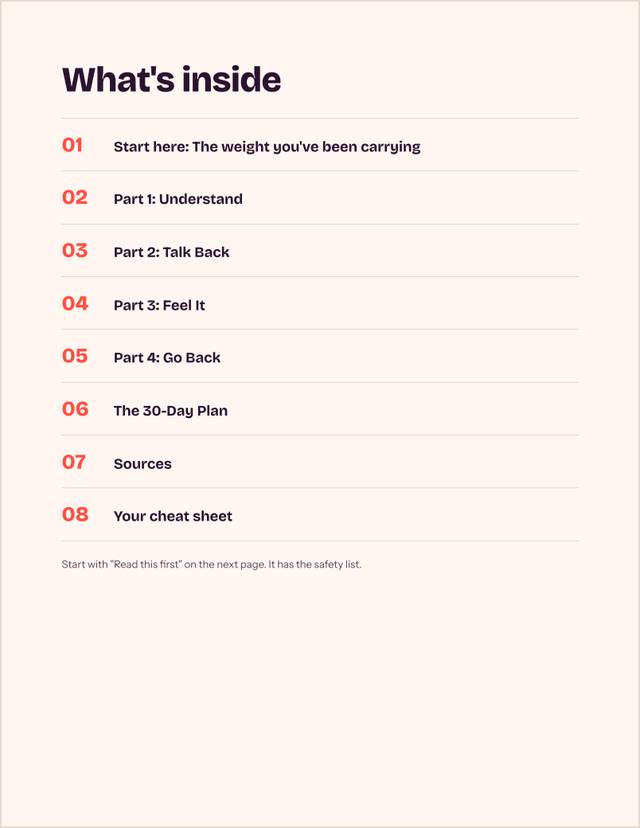
- The guide, with the studies30 pages
- What to say back, word for wordScripts
- The bedtime audio16 min
- The cheat sheet and bad-day planPrint it
Hear the first 30 seconds of the bedtime audio:
One payment · Nothing renews · Apple Pay, Google Pay or card
The Good Days Guarantee
Try it for 30 days. If it isn't for you, reply to your receipt and you get all $19 back. No form, no questions.
Want the daily practice too? $59 once
Everything in the Guide, plus 30 days of 10-minute practice in the app and a short email each morning.
Start the 30 days, $59Or start with the Guide and add the 30 days later for $40.
| One physical therapy visit, without insurance1 | $50 to $350 |
|---|---|
| A pain app, per year2 | $60 to $192 |
| The Good Back Days Guide | $19 once |
1 Hinge Health physical therapy cost guide, 2025. 2 Published annual prices of chronic pain apps such as Pathways and Curable, 2026. This doesn't replace your doctor or physical therapist: have them check you first.
Questions, answered.
So it's all in my head?
No. The pain is in your back, and it's real and physical. Your brain is producing it, which is different from imagining it. Blushing works the same way, and your face really does turn red. Sometimes the brain's alarm stays on after an injury heals. An alarm can be turned down.
My MRI shows a herniated disc.
It might matter, and your doctor should weigh in. But a scan can't tell you which finding hurts. In a review of 3,110 scans of people with no back pain at all, 37% of 20-year-olds already showed disc degeneration. By 80 it was 96%.
I've tried everything.
PT, the chiropractor, injections. They all treat your back. If each one helped for a while and then wore off, that's a clue your back isn't what keeps the pain going. This works on your brain's side of it. It doesn't work for everyone, which is why the refund exists.
Should I stop seeing my doctor?
No. A doctor should rule out anything serious first, and anything new or getting worse goes to them. Keep the care that's helping. This is education, not medical care.
How long until I notice something?
In the Colorado study the big change came over four weeks. Some people notice the fear getting quieter first. Some take longer, and it doesn't work for everyone, which is what the refund is for. Results vary.
Is this the mind-body thing? What's it called?
Yes. Researchers call it pain reprocessing therapy, and it grew out of the mind-body approach to back pain that more than a million people have read about. We teach the same ideas in plain words, at home, for a lot less than a clinic.
I've had back surgery. Does this still apply?
Often, yes. If the pain came back after a surgery that was supposed to fix it, or moved somewhere new, that's exactly the pattern. Ask your surgeon first, and do this alongside their care.
Do I need the app, or is the guide enough?
The guide explains it and gives you the scripts. The 30-day program is where it sticks: a short lesson, a guided session and one thing to try, every morning. If you only read, start with the guide. You can upgrade to the program later for the difference.
Is this backed by real research?
Yes. Everything we teach comes from peer-reviewed studies, the kind checked by other scientists before they're published. Every number on this site links to the study it came from, and the science page walks through each one. We're not doctors, and this is education, not medical care.
Why hasn't my doctor told me this?
Most appointments are short and built around finding damage. The research on retraining the brain is newer: the University of Colorado trial was published in 2022. You can bring it to your next appointment.
Is this a subscription?
No. One payment, nothing renews. The Guide is $19 and the Program is $59, and both come with the Good Days Guarantee: if it isn't for you, reply to your receipt within 30 days and you get every dollar back. There's no fine print.